
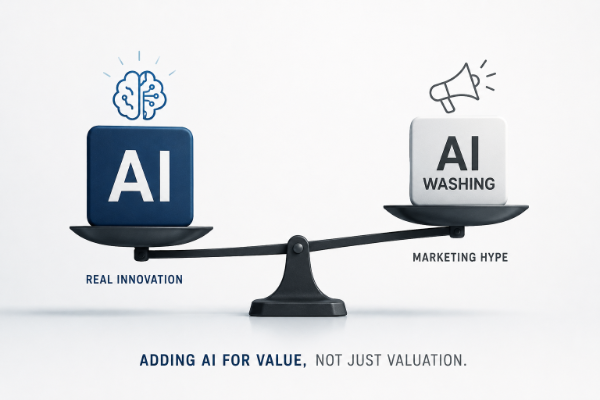
The AI Gold Rush
AI went mainstream in 2022 with the launch of ChatGPT, with millions of users exploiting this revolutionary tool for convenience and efficiency in their work and daily tasks. Today, AI has evolved at an exponential rate and has become increasingly prevalent in our day-to-day lives, almost becoming inescapable. The rise of new agents such as Claude, Gemini, and Grok have facilitated many specific tasks such as coding, researching, and decision making.
As shown by several surveys conducted by McKinsey:
· “62% of survey respondents say their organizations are at least experimenting with AI agents.”
· “Respondents report use-case-level cost and revenue benefits, and 64 percent say that AI is enabling their innovation. However, just 39 percent report EBIT impact at the enterprise level.”
The question that should be asked is if these companies are integrating AI into their workforce because it is worth the price they pay, hence it accelerates and facilitates tasks, or do they only integrate AI for the hype around it and to attract investor attention.
What is AI-Washing?
As AI evolves, businesses begin to incorporate it into their daily tasks; however, many businesses who do so are considered forward thinking, and whose goals are to attract investors with promises related to the integration of AI. As DWF Group states, this has given rise to AI-Washing: “the practice of companies overstating or misrepresenting their AI capabilities or prospects.”
The Stock Market Trap: Why Companies Can’t Stay Quiet
Many companies are pressured to work out a way to integrate AI into their workforce to boost stock performance. As shown in this chart given by Factset, the use of the word AI and similar topics has seen an exponential increase in the past 10 years within company reports in the S&P 500, which illustrates the imperativeness to make AI related announcements to attract investors and boost stock performance.
Real Innovation vs Marketing Hype
While some companies “are seeing 300% ROI within six months” with the integration of AI into their workforce, says Medium, other companies do it purely to join in on the AI bandwagon, or do it incorrectly. To integrate AI into a company and exploit its full potential, a company must follow three filters when evaluating AI innovation cases: value creation, generates new revenue; scalability, can it grow without increasing large costs; and differentiation, does it put the company ahead of the competition. According to McKinsey’s 2025 State of AI report, these three dimensions see companies being 2.5x more likely to find returns from their AI investments.
Here are 3 case studies of companies integrating AI into their day-to-day lives: one that turned out successful, another that didn’t, and a third that did it only for market hype.
· Successful: Before creating their contract intelligence platform, JPMorgan’s legal team reviewed over 12,000 commercial loan agreements, which took around 360,000 hours of lawyer time. The AI platform extracted key data and accelerated the process of reviewing the loan agreements.
· Unsuccessful: Amazon designed and built an AI to review resumes and to facilitate the recruitment process. The only inconvenience was that the AI was downgrading female candidates and giving them an unfair disadvantage. The reason for this error was because it was trained using 10 years of Amazon’s hiring data, which was predominantly male.
· Market Hype: An ecommerce startup Nate was charged with fraud for falsely claiming that the company integrated AI into their app to accelerate the payment process “on any retail site using AI, reducing the checkout process to a single tap,” says digital commerce 360. However, it was not AI doing the work, it was human employees that the CEO hired. Before all the accusations, the CEO raised “more than $40 million from venture capital firms.”
The only distinction that can be made between the second and the third case study is that, while Amazon’s failure was due to bad data, Nate’s failure was a morale/legal error, which was done to attract investor attention.
Conclusion: The Risks of AI-Washing and the AI Bubble
When companies are AI-Washing, they are misleading investors and hyping up their stock because of that, creating asymmetrical information between the company and the market/investors. However, as we can see from the example with the Nate startup, if people discover that the effects of AI on the company’s performance are misrepresented, the stock will plummet, causing many investors to lose money, and the company will find itself drowning in lawsuits. Additionally, if more companies use this practice of AI-Washing, the situation could mimic the U.S. financial crisis, where there was a misrepresentation of information, and the housing bubble, in this case the AI-bubble, could pop.
On the other hand, if you look back at the data provided by McKinsey, “39 percent [of companies] report EBIT impact at the enterprise level,” this 39% are the companies that are going to be the survivors when this AI bubble pops, and the true innovators in the AI era.
Sources:
· The State of AI: Global Survey 2025 | McKinsey
· AI washing: Understanding the risks | DWF Group
· Nate CEO is charged with fraud over fake AI claims